This post and the series it kicks off is meant for anyone serious about understanding how modern networks actually work. If you're stepping into tech for the first time and want a clear picture of what happens behind the scenes when devices connect, or you're already in the field and need to revisit the underlying principles that everything else is built on, this is for you. No advanced prerequisites, no surface-level explanations - just core ideas, explained with clarity and purpose.
Networking Fundamentals
This post and the series it kicks off is meant for anyone serious about understanding how modern networks actually work. If you're stepping into tech for the first time and want a clear picture of what happens behind the scenes when devices connect, or you're already in the field and need to revisit the underlying principles that everything else is built on, this is for you.

Who Will Benefit from This Series?
Why Understanding Networks Matters?
Every digital interaction - browsing a website, sending a message, streaming a video - relies on network communication. Understanding how networks work helps you make sense of the systems behind the scenes. Whether you're configuring devices, troubleshooting issues, writing code, or analyzing traffic, a solid grasp of networking gives you control, insight, and the ability to solve problems that surface across nearly every area of technology.
Control and Insight
Understanding networks gives you control over systems and insight into how they operate.
Problem Solving
Network knowledge helps solve problems across all areas of technology.
What Is the Internet?
The internet is a vast, global system of interconnected networks that enables communication, data sharing, and access to resources across billions of devices. It links together private, public, academic, business, and government systems ranging from local setups to global scale infrastructure.
1
Historical Origins
Its roots go back to ARPANET, a project launched in 1969 by the U.S. Department of Defense. ARPANET was the first network to connect distant computers for research communication. It laid the foundation for internetworking.
2
TCP/IP Development
In the late 1970s, the development of TCP/IP (Transmission Control Protocol and Internet Protocol) standardized how data moves across different systems. This protocol suite made it possible for diverse networks to connect reliably, forming what we now call the internet.
3
Physical Infrastructure
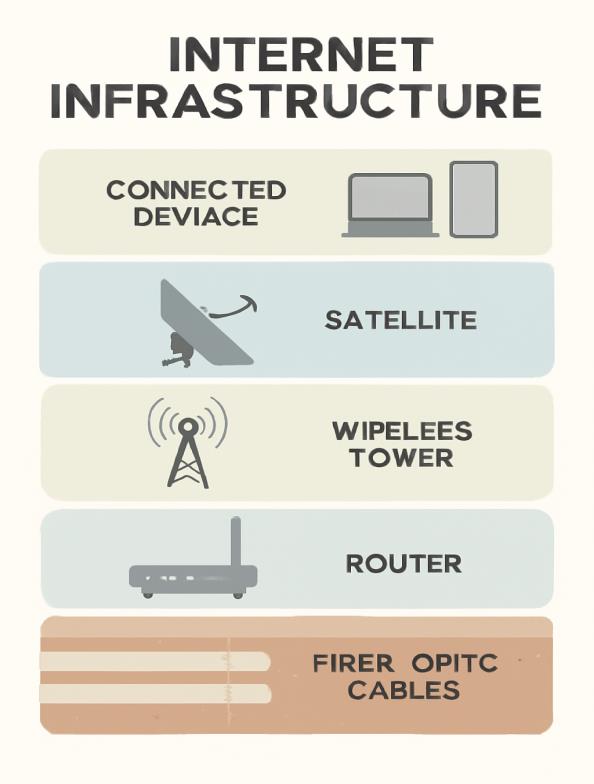
The internet runs on physical infrastructure: fiber-optic cables, copper lines, satellites, routers, and wireless towers. Every connected device is assigned an IP address, a unique identifier that ensures data gets to the right place.
What Are Communication Protocols?
Communication protocols are like shared languages that computers use to talk to each other. Just as two people need to speak the same language to have a conversation, two devices need to follow the same set of rules - a protocol - to understand and exchange data.
1
Protocol Importance
Without these common rules, devices might still send signals, but they'd be meaningless - like shouting in a foreign language and hoping for a reply. Protocols make sure that data is packaged, sent, received, and understood correctly on both sides.
2
Analogy: Letter Sending
Think of it like sending a letter: you need an envelope, an address, a return address, and a stamp. If any part is missing, the letter might not arrive or won't make sense when it does. Communication between devices works the same way.
Common Examples
HTTP for web browsing, FTP for file transfers, SMTP for emails, TCP/IP as the internet backbone.
Smooth Communication
Protocols keep network conversations smooth, orderly, and meaningful.
The OSI Reference Model
The OSI (Open Systems Interconnection) reference model is a conceptual framework that helps us understand how different parts of a network interact. It was developed as a universal standard to guide vendors, developers, and engineers in designing systems that can communicate with each other, regardless of their internal structure.
1
Layered Approach
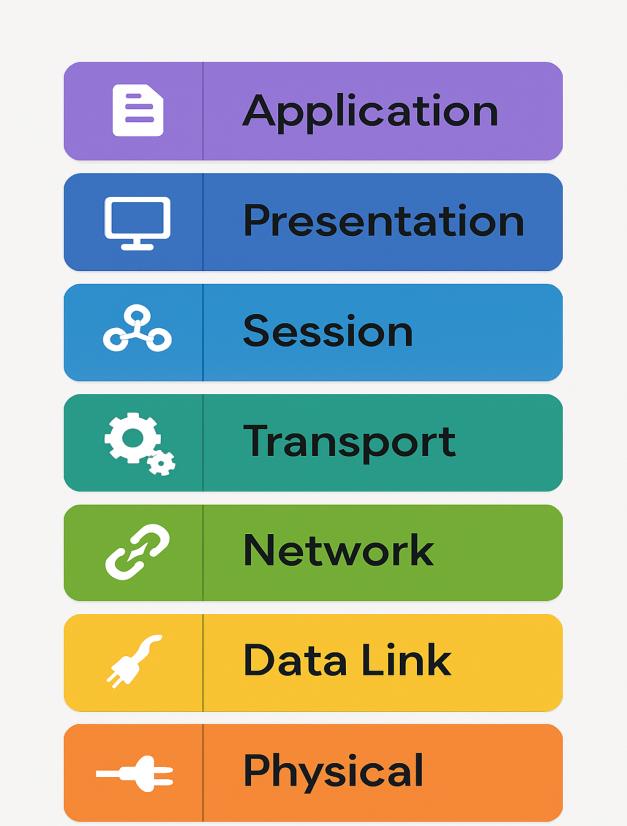
The OSI model breaks down the complex process of network communication into seven distinct layers, each responsible for a specific function. This layered approach makes it easier to design, troubleshoot, and understand networks.
2
Standardization Purpose
Just know that the OSI model exists to bring clarity, structure, and standardization to how networks operate.
Wrapping Up
In this post, we introduced the core of modern networking - what the internet is, where it came from, and how communication between devices works using shared protocols. We also touched on the OSI model, a key reference point for understanding the architecture of networks.
Key Takeaways
Internet fundamentals, protocol importance, and OSI model understanding.
Foundation
Solid foundation for understanding network communication.
What's Next
In the next post, we'll break down the OSI model layer by layer, explaining what each one does, why it exists, and how it fits into the bigger picture of network communication.
Ready to Master Networking?
Contact us for advanced network security assessments and infrastructure analysis.
GET ASSESSMENT