+91 91524 45255

Satellite Hacking 101

Satellite cybersecurity is no longer theoretical. As space becomes commercialized and accessible, understanding how satellite systems operate and where they fail is critical for modern security researchers.

Satellite Security

1. What "Hacking" Actually Means for Satellites

Most people associate the term hacking with three things which include password theft and Instagram account breaches and laptop malware attacks. That mental model completely breaks when you move into satellites.

Satellite hacking isn't about breaking into a website. It's about controlling a machine that you can't physically touch, can't reboot manually, and can't fix once something goes wrong.
Network Discovery

A satellite travels around the Earth at extreme velocities and its operations depend entirely on software control. If that software is abused, the satellite will happily follow along.

Network Discovery

In practice, hacking a satellite usually means one of these things:

In practice, hacking a satellite means:

  1. Sending commands you were never supposed to send
  2. Faking or manipulating telemetry data
  3. Crashing the onboard computer
  4. Locking out the real operators permanently

There's no "factory reset" in orbit.

That's what makes this field high-risk and high-impact.

2. How Satellites Are Really Controlled

Let's strip away the sci-fi nonsense.

A satellite is not an intelligent autonomous being. It's a computer. A very constrained one, running specialized software, doing exactly what it's told.

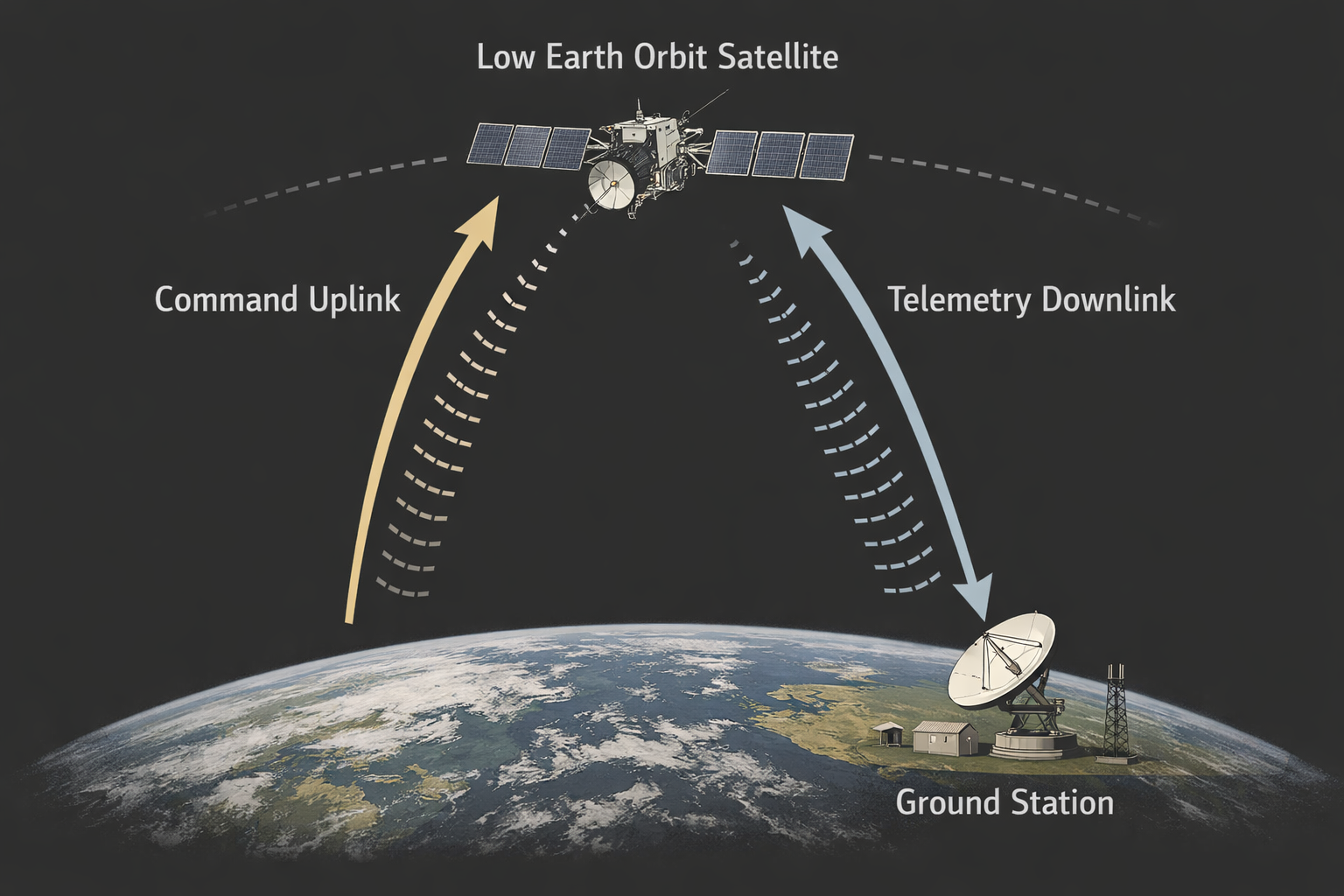
Every satellite contains an onboard computer system that runs flight software. The software controls satellite operations by processing commands and managing systems and determining subsequent actions of the satellite. Earth receives information from the satellite through its radio communication system. The system operates in this manner without any supernatural elements.

Everything happens in a loop:

Everything happens in a loop:

  1. A ground station sends a command
  2. The satellite receives it over radio
  3. The software parses it
  4. The command gets executed
  5. Telemetry is sent back

This loop runs constantly throughout the mission.

Here's the important part:

the satellite does not understand intent.

If the software accepts a command, it will execute it. It doesn't know whether that command came from NASA, a university lab, or an attacker with a radio and too much free time.

Security lives entirely in the software. The satellite system becomes vulnerable to attacks when its software security features become compromised.

3. Why Satellite Security Is a Real Problem

This is where beginners usually get uncomfortable.

A lot of real satellites do not have strong security.

Not because engineers are stupid, but because of history and constraints.

Many satellites are based on old designs created when cybersecurity wasn't a concern. Computing power is limited, so heavy crypto and modern protections are often avoided. Budgets are tight, especially for academic and experimental missions. And for a long time, there was a quiet assumption that space was "safe" simply because it was hard to access.

That assumption is dead.

The public now has access to build ground stations using standard hardware components. Open-source flight software is available for public use. Every year universities launch CubeSats into space. The space industry has multiple commercial satellite networks operating throughout its territory.

And this isn't hypothetical. Researchers have already shown what goes wrong in the real world: command interfaces that accept instructions without authentication, debug commands that were never disabled before launch, memory corruption bugs sitting in flight software, and firmware update mechanisms with little to no protection. These aren't edge cases. They're structural failures that fall straight out of how these systems are designed and operated.

Satellite Security Research

Image credit: Original photo by u/ewarfare on Reddit. Used for educational purposes.

4. Where Satellites Are Most Vulnerable

You don't need a PhD to understand the main attack surfaces.

Radio Command Interface

If commands aren't encrypted or authenticated properly, a satellite can't tell who's talking to it. If it hears something that looks valid, it will listen.

That's it. No drama.

Flight Software Bugs

Most flight software is written in C or C++. That means memory bugs are not rare — they're expected.

Common problems include:

  1. Buffer overflows
  2. Unsafe packet parsing
  3. Trusting packet length fields
  4. Dangerous debug commands

One bad bug in the right place can mean total control.

Ground Systems

Even if the satellite software is solid, the ground systems might not be. Weak passwords, misconfigured networks, or sloppy access control can lead to indirect compromise.

Security must be end-to-end.

If any part is weak, the whole system is weak.

5. Why Beginners Struggle With Satellite Security

Here's the part no one says out loud.

Most beginners fail because they skip fundamentals.

They jump straight to "hacking" without understanding how satellites work. They don't know how flight software is structured. They don't understand command and telemetry. And they don't have access to real hardware.

Traditional cybersecurity labs focus on things like websites and servers. You can spin those up on your laptop, break them, and see instant results. That makes learning feel manageable.

Satellite systems are nothing like that.

They use custom protocols. They run embedded software. They have real-time constraints. Software behavior is tied to hardware. And you can't just SSH into a real satellite to experiment.

So beginners either read dense research papers and feel completely lost, or they get overwhelmed and quit.

That's not a skill issue. It's a learning-path issue.

6. How We're Going to Learn This (The Right Way)

There is no shortcut here.

The correct path looks like this:

1

Understand Flight Software First

Before you touch anything labeled "security," you need to understand how commands actually move through the system, how telemetry is generated and sent back, and how the onboard software is structured to tie all of that together.

No exceptions.

2

Use a Safe, Local Environment

This is where OpenSatKit (OSK) matters.

OSK lets you run real flight software on your own machine. You can send commands, receive telemetry, and see how things actually work — without risking a real mission.

You learn by breaking things safely.

3

Move to Real Hardware

Then comes PiSat, OSK running on a Raspberry Pi.

At this point, you're no longer dealing with toy examples. You're working with real hardware, GPIO lines standing in for spacecraft subsystems, ground-to-"satellite" communication paths, and failure or attack scenarios that look uncomfortably close to what happens on actual missions.

You get hands-on experience without destroying something that cost millions.

Interested in Satellite Security Research?

Contact Amynasec for advanced space systems security assessments and training.

GET ASSESSMENT